Tengu Warrior Field Manual
Roulette Field Manual
Roulette looks simple because the table wants you calm. The Hooded Hacker reads it differently: layout, payout, volatility, table mood, and whether the mathematics says attack, wait, or walk away.
European roulette pockets: 0-36. American wheels add 00 and make the climb steeper.
Straight-up payout on a standard roulette number. High reward, brutal miss rate.
Most roulette systems we test are binned. A pretty curve in one sample means nothing until it survives abuse.
1. The Board In Plain English
Every roulette bet is a trade-off between coverage and payout. Cover one number and you get paid properly when it lands, but the miss rate is severe. Cover half the wheel and you win more often, but one zero can still turn a tidy sequence into a failed plan.
| Bet Type | Covers | Typical Payout | Hooded Hacker Read |
|---|---|---|---|
| Straight up | 1 number | 35:1 | Useful only when the target selection is disciplined. Random darts drain bankrolls. |
| Split | 2 numbers | 17:1 | A tighter way to cover neighbouring layout numbers without going full shotgun. |
| Street | 3 numbers | 11:1 | Small grid coverage. Easy to overuse because it feels safer than it is. |
| Dozen / Column | 12 numbers | 2:1 | Session control tool, not magic. Better for tempo than jackpots. |
| Red / Black | 18 numbers | 1:1 | Simple, but zero is the mathematical tax. |
2. Wheel Types Matter
European and French roulette are usually the cleaner learning ground because there is one zero. American roulette adds 00, which means the house gets a heavier tax. Multiplier roulette adds another layer: the headline win can be bigger, but the base rules, bonus rules, and volatility profile must be read before staking.
Some live bonus roulette variants compress the ordinary number payout to fund the bonus layer. A classic straight-up number is usually described as 35:1, or 36x including the returned stake. A bonus-led table may pay closer to 19:1 or 20:1 on the base number, then advertise a giant top prize. That trade is the whole story: the headline gets bigger, but the everyday hit is weaker and the path to the huge win has more conditions.
| Table Shape | Base Number Return | What Members Must Understand |
|---|---|---|
| Classic single-zero roulette | Typically 35:1 profit, 36x including stake | The simple version: one number hits, standard straight-up return applies. |
| Live bonus roulette variant | Often reduced, around 19:1 or 20:1 profit depending on rules | Part of the payout has moved into the bonus mechanism. The headline prize is not free value. |
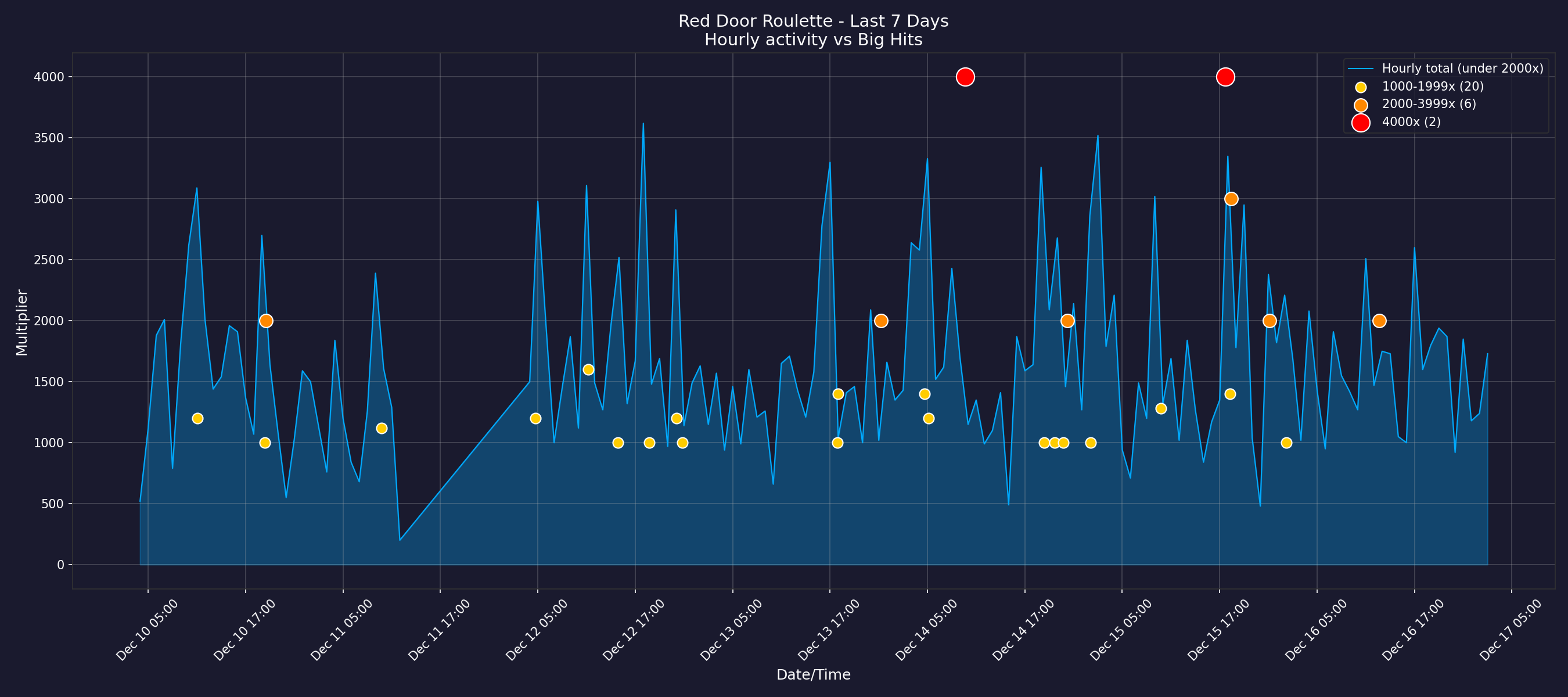
| Headline jackpot route | Extreme top-end multiplier | Requires multiple things to align, including the bonus/flapper layer. Treat as rare-event volatility, not a normal target. |
3. Strategy Systems: The Graveyard
Martingale, Fibonacci, D'Alembert, Paroli, flat staking: they all get dressed up as systems. Most are just ways to move variance around. The casino's base edge is known; the bigger danger is when a small edge becomes a psychological trap through chasing, doubling, and "one more spin" thinking. At TenguBet we test hundreds of variants across real table histories. Almost all of them lose money once the sample gets ugly enough.
The odd gem is different. It survives boring days, nasty streaks, missing signals, table limits, and the moment where a human would normally tilt. That is the mission: swing the mathematical odds away from the casino and toward the member wherever a real edge survives. When something survives that, it may become a strategy page or a tool. We share the data, table context, and operating conditions members need to test their own ideas.
Use The Live Tools, Not Guesswork
For roulette sessions, start with the live roulette hub and member tools. They show table context, alerts, heat, dominant sectors, recent pressure, and status so members can work from evidence.
4. Session Instructions
Choose the table type first: classic, speed, auto, multiplier, or live bonus roulette. Do not mix rules in your head.
Define session budget, stake size, loss stop, and win withdrawal before the first chip lands.
If a TenguBet tool says wait, review, stale, or no live feed, treat that as part of the decision.
Wins are easy to remember. Bad entries teach more. Keep the receipts.
Tengu Tip: Test The Table First
Before committing to a proper session, the Warrior can test the table with tiny stakes. This is not proof and it is not a prediction. It is a cheap table-temperature check: is the game immediately paying your simple cover, or is it collecting against you from the first move?
| Test | Example | Read | Action |
|---|---|---|---|
| Tiny outside cover | 10p on Red, 10p on Even, 10p on Low | You are testing a broad simple position with minimal exposure. | Observe the result before escalating. |
| Hostile first result | Black, Odd, High | The spin beat all three parts of the test cover. | Quit now, reload, or try a different table. Do not argue with the opening read. |
| Mixed result | One or two parts pay | The table is not instantly hostile, but it has not proven anything. | Keep stakes tiny and check the tool state. |
| Clean pay | Two or three parts pay | The table is at least not collecting against the first simple probe. | Continue observation; do not jump straight to full stakes. |
Warrior rule: a test bet is a cost-controlled question. If the table answers with a clean collect against your probe, leave cheaply. Reloading or changing table is better than trying to win an argument with the first hostile read.
5. Dominant Sectors: What, How, And Why
A dominant sector is a section of the wheel that appears to carry more of the recent action than the rest of the wheel. It is not the same as a hot number on the betting layout. The layout puts numbers in rows; the wheel puts numbers in a physical order. Sector reading cares about neighbours on the wheel, not neighbours on the felt.
TenguBet's roulette feed is built to make that easier to see. Instead of staring at a long list of recent numbers, members can watch whether the pressure is scattered, clustered, rotating, fading, or sitting around a physical wheel zone. The Hacker is asking: is the table spreading results cleanly, or is a zone carrying unusual weight in this live window?
What Does 58% Mean?
On the Tengu roulette feed, the centre percentage is the share of the defining recent spin window that landed inside the highlighted primary sector. A 58% read is one example: 7 of the last 12 spins landed inside that 9-number wheel section.
The same rule applies at every level. The percentage is a concentration read, not a next-spin promise. It tells members how much of the recent live window has been carried by the highlighted wheel zone.
Sector Strength Levels
| Level | Typical Read | What It Means | Member Action |
|---|---|---|---|
| No active sector | Below the display threshold | Recent results are too scattered for a clean wheel-zone read. | Do not invent a sector. Use other tools or stand down. |
| Watch | Roughly 40-49% | A zone is forming, but not strong enough to treat as a main read. | Observe. Record it. Avoid chasing early. |
| Active | Roughly 50-58% | The primary 9-sector is carrying a material share of the recent window. | Use the sector as live context and compare with tool status. |
| Strong | Roughly 59-66% | The recent window is tightly concentrated in one wheel zone. | Check whether the micro sector supports it. Watch for fade. |
| Overheated | 67%+ | The zone has been carrying a very heavy share of the recent window. | High attention, high fade risk. Do not assume it keeps paying. |
| Fading | Percentage dropping or chips spreading | The earlier concentration is breaking up. | Stop treating the old zone as active pressure. |
The exact thresholds are guide rails, not commandments. The important behaviour is the change: forming, active, tightening, overheating, or fading. A lower number that is rising can matter more than a higher number that is already collapsing.
How Members Should Read The Tengu Sector Card
| Card Element | What It Means | How To Use It |
|---|---|---|
| Highlighted wheel arc | The physical wheel section currently carrying the strongest recent concentration. | Read it as the active pressure zone, not as a prediction. |
| Centre percentage | The share of the recent sector window landing inside the highlighted zone. Example: 58% means 7/12. | Higher means tighter recent concentration. It does not mean guaranteed next-spin probability. |
| Ratio under percentage | The raw hit count behind the percentage. | Always read this with the percentage. 7/12 is more useful than a naked 58% label. |
| Number chips | The actual wheel pockets inside the current primary 9-sector. | These are wheel neighbours. Do not translate them into table-layout neighbours. |
| Micro sector | A smaller support zone inside or near the main sector when the read is tight enough. | Useful for focus. If hidden, the wider sector may be too loose. |
| No active sector | The live window is not concentrated enough to show a clean sector read. | Stand down from sector thinking. Do not invent a sector manually. |
Warrior Rule
A sector card is a map of recent pressure, not permission to chase. If the card shows a tight sector, members can watch that zone and compare it against their own notes. If the card fades, disappears, or spreads out, the Warrior lets it go.
Sector Names Members Will See
There are traditional sector names, and there are TenguBet live-feed names. Traditional names describe known wheel areas. TenguBet names describe the current live pressure: which zone is carrying the recent results, whether a smaller micro-zone supports it, and whether that pressure is fading.
| Name | Plain Meaning | Tengu Use |
|---|---|---|
| Voisins du Zero | The large wheel area around zero. | Useful reference when recent pressure sits around the zero side of the wheel. |
| Tiers du Cylindre | The opposite-side wheel third, commonly associated with 27 through 33 style neighbours. | Useful when pressure forms away from zero-side traffic. |
| Orphelins | The orphan pockets not covered by the two big named groups. | Useful when the action avoids the obvious major sectors. |
| Zero Spiel | A tighter zero-neighbour group. | Useful for narrow zero-side observation, not a guarantee. |
| Primary 9-sector | TenguBet's strongest current 9-number wheel zone. | Main live sector read when the recent window is concentrated enough. |
| Micro sector | A smaller supporting wheel zone. | Shows whether the main read has a tighter core or is too spread out. |
The European Wheel Order
This is why layout thinking misleads people. On the table layout, 8 and 23 sit near each other. On the wheel they are also neighbours. But many layout neighbours are physically far apart. Sector work starts from this wheel order:
Example: Tengu Primary 9-Sector
If the live feed says the anchor is around 8, the 9-number wheel sector is not "numbers near 8 on the table layout". It means 8 plus four physical wheel neighbours each side.
| Term | What It Means | Why It Matters |
|---|---|---|
| Dominant sector | A physical slice of the wheel carrying repeated recent landings. | Can guide observation and target testing better than layout-only hot numbers. |
| Neighbour pressure | Numbers beside the hit zone on the wheel also appearing. | Suggests a wider landing area rather than one isolated number. |
| Sector fade | A visible zone stops producing after members notice it. | Prevents chasing a sector after the window has closed. |
| Layout illusion | Numbers look related on the felt but are far apart on the wheel. | Stops members building false patterns from the wrong map. |
6. How Casinos Fight Sector Reading
Casinos know that physical roulette can leave clues if the wheel, dealer, ball, or table procedure becomes too repeatable. Modern operations fight that in several ways. Manual dealer tables rotate staff frequently, change spin rhythm, alternate spin direction, inspect wheels, replace balls, and maintain wheel balance. The goal is to stop one dealer, one ball, or one wheel condition becoming a readable signature.
Auto machines remove the human dealer but add their own controls: fixed launchers, calibrated wheels, sensors, maintenance routines, and consistent mechanical release systems. They reduce dealer signature, but they still have physical parts, ball scatter, pocket geometry, deflectors, and wear. The Warrior does not assume "auto" means impossible or easy. He waits for data.
Modern wheel design also works against clean prediction. Deflectors, sometimes called diamonds, knock the ball away from a smooth path. Frets and pocket shape make the final bounce messy. The ball can ping around the wheel after it leaves the track, which is exactly the point: a readable launch becomes a chaotic landing.
Human Dealer vs Automated Wheel
| Table Type | What Can Create A Read | What Voids It | Member Rule |
|---|---|---|---|
| Human dealer | Dealer rhythm, release style, ball speed, spin direction, fatigue, table routine, wheel condition. | Dealer change, long break, ball change, wheel maintenance, obvious rhythm change, feed gap. | If the dealer changes, the old dealer-dependent read is void. Start a new observation window. |
| Automated physical wheel | Launcher rhythm, mechanical release, ball scatter, pocket geometry, maintenance condition. | Machine reset, maintenance, ball/wheel intervention, long outage, visible behaviour change. | No dealer reset, but machine-state changes still reset confidence. |
| RNG roulette-style game | Software result distribution, repetition, number bias, streak behaviour, and payout design. | Game version change, rules change, feed/data issue. | Do not apply human dealer logic. Use the tracker to watch number distribution and repeats. |
| Live wheel plus RNG bonus | Physical wheel for number result, software layer for bonus/multiplier selection. | Dealer or machine change affects wheel read; bonus-rule change affects bonus read. | Keep the wheel read and bonus read separate. |
Dealer Change Rule
On a human-dealt table, a dealer change voids the prior dealer-dependent sector and rhythm read. The wheel may be the same, but the release, tempo, fatigue, and routine have changed. The Warrior resets the notes and waits for fresh data.
7. Live Wheels, RNG Games, And Hybrids
Not every roulette-style product is the same battlefield. A live manual wheel is physics plus human procedure. An auto wheel is physics plus machine procedure. A pure RNG game is software output mapped into game results. Some live bonus games mix a physical wheel result with RNG-driven bonus selection or multiplier assignment. Members must know which layer they are reading before they trust a pattern.
| Game Type | Main Randomness Source | What TenguBet Watches |
|---|---|---|
| Manual live wheel | Dealer spin, ball physics, wheel condition | Dominant sectors, dealer rhythm, wheel zones, recent table state. |
| Auto physical wheel | Mechanical launcher, ball physics, wheel condition | Sector clustering, machine rhythm, maintenance-sensitive behaviour. |
| Pure RNG roulette-style game | Software random number generation | Result distribution, number bias, repetition, streaks, timing, payout design, and whether any live pattern claim is actually relevant. |
| Live wheel plus RNG bonus | Physical number result plus software-selected bonus layer | Separate the wheel read from the bonus/multiplier read. Track both, but do not mix the two maps. |
RNG Tracker Rule
RNG games do not have dealer signature, ball release, or wheel-sector physics in the same way as live wheels. They can still show number bias, repetition, streak clusters, cold gaps, or unusual distribution behaviour. That is why TenguBet gives members tracker tools: use the tracker for RNG behaviour, not dealer logic.
8. Mistakes The Table Wants From You
The Due Number Trap
A cold number is not automatically owed. Cold can be useful only when a tested tool says the wider conditions matter.
The Hero Stake
Big stakes feel powerful for eight seconds. Bad staking turns a decent read into bad mathematics.
The Screenshot Strategy
One huge win proves nothing. We care about repeatable behaviour across hostile samples.
Reference structure cross-checked against public roulette rules, bankroll guidance, and casino etiquette material. TenguBet copy is original and member-facing.